Believe it (or Not)
Online summer camps that help you divide fact from fiction

What’s real?
Increasingly, kids are surrounded by nonsense.
TV, YouTube, the news — even some library books! — are peppered with fake reports invented to get clicks. And AI video threatens to make lies more convincing.
And yet the world really is filled with wonder. Bizarre phenomena abound! How can you tell what’s real?
In this series of week-long classes stretching across three summers, kids dove into claims of the strange. We took them on a brains-on adventure, teaching the thinking tools to help them think more rationally for the rest of their lives.
Each summer, we tackled a new topic:
June 2024: Bigfoot
June 2025: Sea monsters
June 2026: UFOs
In each, kids learned a lot of fascinating lore about the topic, but we also used each topic to learn more about the subtle art of thinking rationally.
Each course is four or five lessons of 90–120 minutes. They’re for students 8 and up. And they build — the tools learned in one topic continue through to the next.
The three topics
#1
Believe it (or not): Bigfoot
What are the odds that Bigfoot exists? They’re not 100%… but they’re not 0%, either!
This course is on “cryptids” — animals that are rumored to exist, but which haven’t been confirmed by science.
Lesson 1
Type of evidence: cultural stories & expert opinion
Tool of reasoning: probabilities
Where does the idea of Bigfoot come from? In this lesson, we’ll explore cultural stories of Sasquatch and other bipedal apes from around the world, and we’ll look at some famous experts (like Jane Goodall and David Attenborough) who believe it exists. We’ll also do a quick math review of how probabilities work, and preregister our guesses.
Lesson 2
Type of evidence: paleontology
Tool of reasoning: base rates
If Bigfoot existed, what kind of animal would it be? How closely related would it be to us? And what kind of evidence is there of such a creature ever existing? In this lesson, we’ll unearth human prehistory, and look at the fossil evidence of Bigfoot-like animals. We’ll also tell the story of how Daniel Kahneman discovered that humans are terrible at considering “base rates”.
Lesson 3
Type of evidence: eyewitness reports
Tool of reasoning: conditional probabilities & counterfactual thinking
What do we make of the fact that so many people claim to have seen Bigfoot? In this lesson, we’ll dive into the psychology of personal testimony. You’ll learn how perception and memory influence storytelling. We’ll also learn about how understanding conditional probabilities (and counterfactual thinking) is crucial for thinking clearly.
Lesson 4
Type of evidence: photographs & films
Tool of reasoning: Bayes’ theorem
What about the photos? What about the films?! In this lesson, we’ll look closely at the details of the famous 1967 Patterson-Gimlin film. You’ll learn how to tap into a community of thinkers. We’ll also (finally!) put together what we’ve been learning and unveil Bayes’ theorem.
Lesson 5
Type of evidence: physical evidence
Tool of reasoning: (practice using Bayes’ theorem)
What would it take to prove Bigfoot is real? How close do we come to that? In this lesson, we’ll examine the physical evidence that’s been brought forward for Bigfoot: hair samples, nests, and (of course) footprints. We’ll bring this all together with Bayes’ theorem, and show you how to become an intuitive Bayesian thinker.

#2
Believe it (or not): Sea Monsters
Are sea monsters real? The Loch Ness Monster is just the beginning — people all around the world report seeing huge animals in the oceans (and lakes) that science doesn’t recognize.
Sometimes they even find bodies.
What should we make of this evidence?
Lesson 1
We start by defining what would constitute a “sea monster”, and reviewing what we learned of Bayesian reasoning in “Bigfoot”.
Lesson 2
We then look to the physical evidence, especially to the Zuiyo-maru carcass, and the St. Augustine Monster. How strong is this? And what do we make of “The Bloop”?
Lesson 3
We go back and think through what our assumptions should be about prehistoric animals surviving into the present. Is it crazy to think that a plesiosaur could have survived the dinosaurs, and still be alive in a Scottish loch now?
Lesson 4
We cap it all off by taking an absurdly close look at the evidence surrounding the Loch Ness Monster… and the stories of where this evidence comes from.

#3
Believe it (or not): UFOs
Are we being visited by aliens? Both the mainstream and alternative media are abuzz with the possibility. And the U.S. Congress has held a hearing about it.
In this 4-day course you’ll learn the tools of “scout mindset” — how to weigh evidence, spot biases, and find the right context — to make up your own mind.
Lesson 1
We start by doing a quick review of the Bayesian method learned in the last two topics, and then talk about the most famous UFO stories — like Roswell, Area 51, and alien abductions.
Lesson 2
We zoom into one particular video that’s claimed to be one of the strongest pieces of evidence in favor of UFOs being aliens: the “Tic-Tac” video by the U.S. Navy.
Lesson 3
We focus on an even stranger video: “Gimbal”.
Lesson 4
We top it all off by taking a look at the stories whistleblowers inside the U.S. government have been telling, sometimes under oath, about what they’ve seen inside secret facilities.
You’re teaching what?
Q: Isn’t this just a bunch of pseudoscience?
This course doesn’t tell kids what to think — it teaches them how to think critically about extraordinary claims, just like real scientists do.
Q: Will my kid be told what to believe?
No. We take every idea seriously — examining the best arguments for and against, and putting them to the test with real scientific methods. We leave the conclusions up to the kids.
Q: Is this a serious educational experience?
These are applied math courses. They’re our most intense courses on scientific reasoning.
Q: What if my kid already believes in one of these things?
Wonderful! Fervent believers, hardened skeptics, and total noobs are all welcome here. These courses are about testing ideas, not shutting them down.
Q: How interactive is this? Will my kid actually engage?
This isn’t a sit-and-listen class. Like all of our small-group seminars, it’s a brains-on, hyper-interactive experience where kids engage, debate, and challenge their own reasoning in real time.
Q: Do they have to take them in order?
We strongly recommend they do — we teach a new skill in every lesson, so they’ll be lost if they start in the middle.
One theorem to rule them all
These aren’t “debunking” courses, and they’re not about “blind belief” either. It’s about thinking like a scientist, which means using Bayes’ theorem. It’s not much to look at…
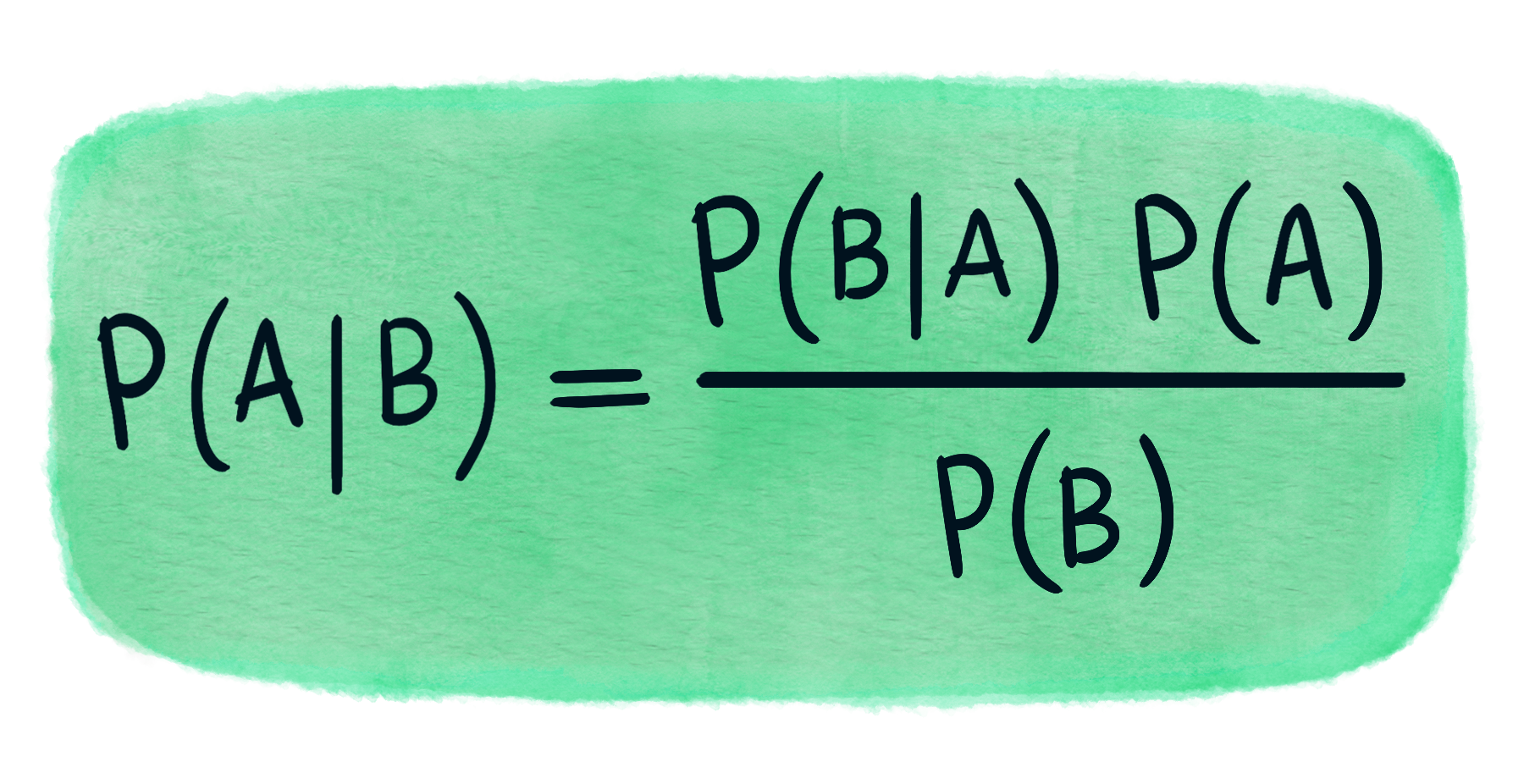
…but, to many scientists, it’s the secret path to rationality.
“…you, a human being, want to learn about Bayes’ theorem.”
Bayesian reasoning is the thread running through the topics. We build it in “Bigfoot”, and use it to show something truly surprising. We help you get used to it in “Sea Monsters”, and help you get fluent with it in “UFOs”.
It’s hard to overstate its power: it helps us escape black-and-white thinking, and spurs us to challenge our own assumptions. It does, however, have limitations… which we’ll call attention to throughout.
If you’re interested, Brandon’s written more about this approach on his Substack, and on Astral Codex Ten.